
All of anatomy, region by region, as one map you understand.
5 regions, each one map: where a structure is, what it does, what you see when it’s injured, and how it’s asked. Explained in Arabic, with the English terms your exams use.
The night before the practical
The notes are open, there are hundreds of slides, and every structure has a long English name. You memorise the branches of the brachial plexus in order, knowing you’ll forget them before you do.
Then comes the question you didn’t practise: “A mid-shaft humeral fracture. What do you expect to see?” You have the fact. It just isn’t connected to anything.
Complete Anatomy ties every structure to its place, its function, what happens when it is injured, and how it is asked. That’s the whole idea.
Who it’s for
- Students in years 1–3 studying anatomy for block and practical exams
- Anyone who knows the names but gets lost on the injury question
Not for
- Anyone looking for a replacement for lectures or practical training
- Anyone who wants a “shortcut” that guarantees a pass
Try it before you join
This is how every region is built.
Map → Function → Lesion → Question. Tap any nerve of the upper limb:
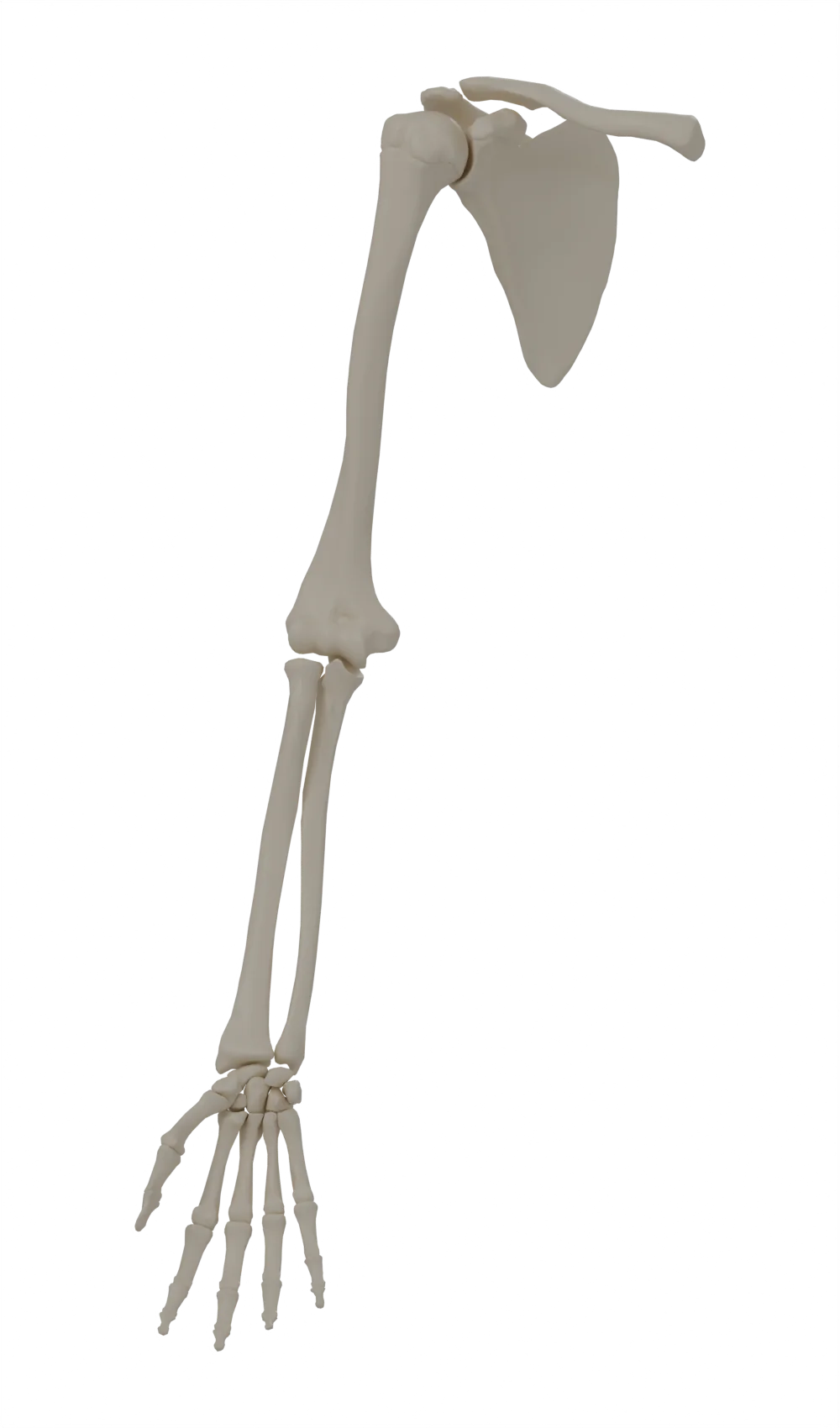
Axillary nerve
C5–C6-
01Map · Where it is, what it relates to
Winds around the surgical neck of the humerus with the posterior circumflex humeral artery, after passing through the quadrangular space.
-
02Function · What it does
Supplies deltoid and teres minor, and the skin over the lower deltoid.
-
03Lesion · What you see when it is injured
Surgical-neck fracture or anterior shoulder dislocation: weak arm abduction, a flattened shoulder contour and a numb patch over the deltoid.
-
04Question · How it appears in the exam
After an anterior shoulder dislocation a patient cannot abduct the arm and has numbness over the deltoid. Which nerve?
Reveal the answer
The axillary nerve
Radial nerve
C5–T1-
01Map · Where it is, what it relates to
Runs in the radial (spiral) groove on the back of the humeral shaft with the profunda brachii artery.
-
02Function · What it does
Supplies the extensors of the elbow, wrist and fingers, and the skin over the dorsum of the hand at the base of the thumb.
-
03Lesion · What you see when it is injured
Mid-shaft humeral fracture: wrist drop and numbness over the back of the hand. Triceps is usually spared because its branches leave above the groove.
-
04Question · How it appears in the exam
A patient with a mid-shaft humeral fracture cannot extend the wrist. Which nerve is injured?
Reveal the answer
The radial nerve
Ulnar nerve
C8–T1-
01Map · Where it is, what it relates to
Passes behind the medial epicondyle of the humerus in the cubital tunnel: the “funny bone”.
-
02Function · What it does
Supplies most of the small muscles of the hand, and the skin of the little finger and half the ring finger.
-
03Lesion · What you see when it is injured
Medial epicondyle fracture: weak finger abduction and adduction, and a numb little finger. Clawing of the ring and little fingers is usually more marked when the injury is at the wrist than at the elbow (the “ulnar paradox”).
-
04Question · How it appears in the exam
After a medial epicondyle fracture a patient cannot grip a card between the fingers and has a numb little finger. Which nerve?
Reveal the answer
The ulnar nerve
Median nerve
C5–T1-
01Map · Where it is, what it relates to
Crosses the wrist inside the carpal tunnel, under the flexor retinaculum, with the long flexor tendons.
-
02Function · What it does
Supplies most forearm flexors and the thenar muscles, and the palmar skin of the thumb, index, middle and half the ring finger.
-
03Lesion · What you see when it is injured
Carpal tunnel syndrome: tingling in the lateral three and a half fingers that is worse at night, weak thumb opposition and thenar wasting.
-
04Question · How it appears in the exam
Tingling in the thumb, index and middle fingers wakes a patient at night, with weak thumb opposition. Which nerve, and where?
Reveal the answer
The median nerve, in the carpal tunnel
What you get
Everything anatomy needs, in one place.
5 regions, each a complete map
Short lessons that build every region in four layers.
Instead of piecing each region together from lectures, notes and YouTube.
A question bank per region
Exam and spotter style, every answer explained.
Instead of hunting for scattered questions before every block.
A lesion sheet per region
Every nerve and artery: what you see when it is injured.
The one page you open the night before the practical, instead of hundreds of slides.
A 7-day plan for every exam
What to study each day in the final week.
So you don’t lose the first two days deciding where to start.
- A printable summary for every region
- A bilingual glossary: the English term with its Arabic explanation
12 months of access from purchase, including updates in that period. Regions: Upper Limb · Lower Limb · Thorax · Internal Organs · Head & Neck.
The full planned curriculum: 5 regions, 27 learning areasThe price
Less than buying regions separately. And clearer.
These are our real list prices, not an invented “was” price.
- One Region Pass
- SAR 49
- Every region separately (5 × 49)
- SAR 245
- Complete Anatomy
- SAR 199
- You keep
- SAR 46
SAR 199 is a lot for a student? Start with one region at 49, which counts in full if you upgrade within 14 days. Or take the free plan first.
Applies from the day enrollment opens
Try it for 7 days. If it isn’t for you, get a full refund.
If you’ve opened no more than two lessons within 7 days of purchase, we refund you in full, no questions asked. We don’t promise you’ll pass; we promise clearer teaching. Refund policy
Who prepares it
Medical content led by a doctor.
Dr. Suhaib Alhaj
Medical content lead
MedixLearn’s medical content is prepared under his lead, written to explain rather than to cut corners: every structure is tied to its function, to what happens when it is injured, and to how it is examined.
Why “Founding Edition”?
The first MedixLearn enrollment.
List members hear the opening date and the founding price before any public announcement, and their votes and exam dates help decide which region we produce first. Nothing to pay now.
Enrollment isn’t open yet · Joining is free and commits you to nothing
Questions
Questions before you enroll
Does it match my university’s curriculum?
Does MedixLearn provide certificates?
How long do I keep access?
When will enrollment open?
What if I buy and it isn’t for me?
How will I pay?
SAR 199 is a lot for a student. Why pay it?
I don’t know you. Why should I trust you?
Not ready to pay?
Fine. Try the method for free first.
A 7-day plan, the upper-limb nerve map, a terminology sheet and 25 questions with explained answers.